What is film, really?
A roll of 35 mm film looks like a strip of brown plastic. Physically it is a precision-coated ribbon of gelatin on a transparent support, and almost every interesting property of a film – its speed, its grain, its colour, its contrast – comes from what is suspended in that gelatin and how thick each layer is.
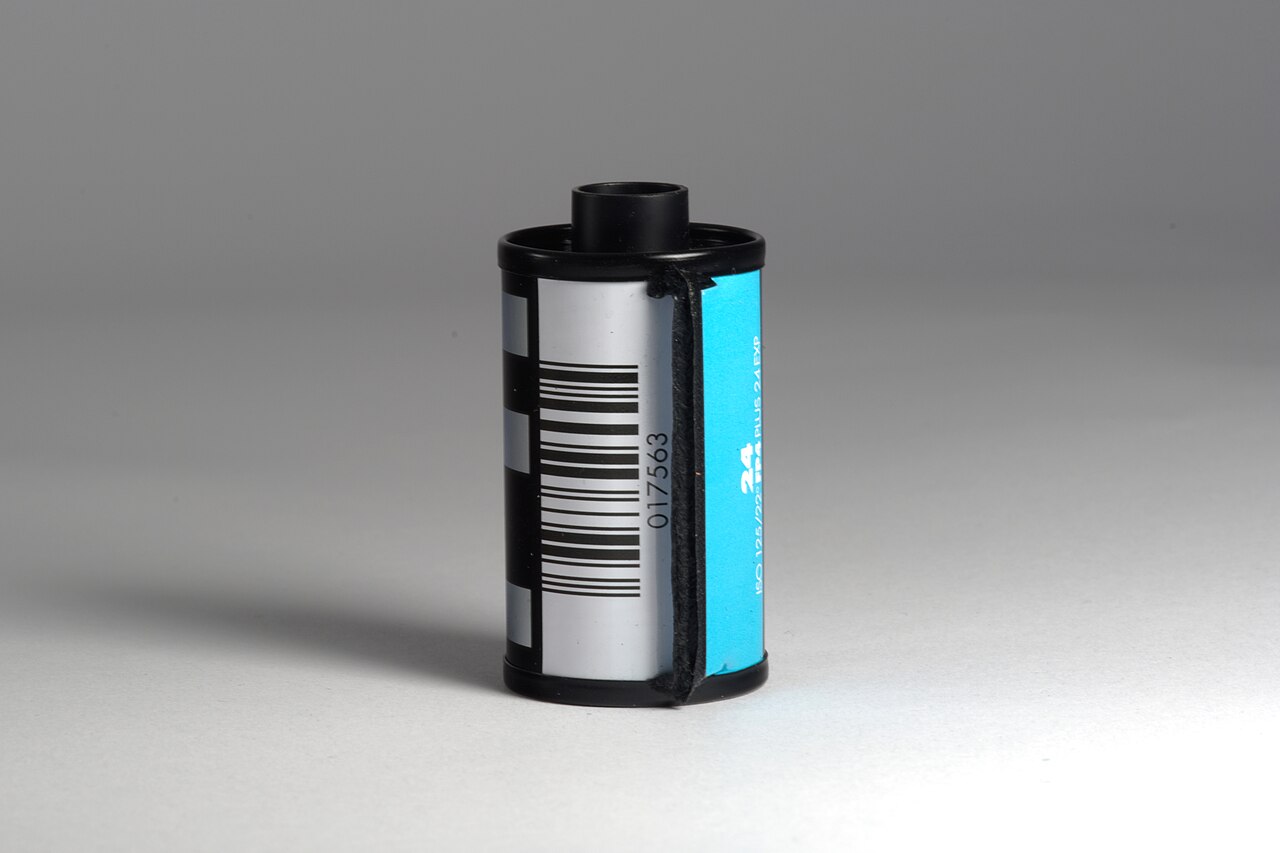
The 135 cassette: a light-tight metal shell, a spool, and a “leader” of film poking out through felt-lined lips. Standardised by Kodak in 1934 around movie-camera film stock. [Photo: VSchagow, CC BY-SA 4.0]
In short
Film is a base (flexible plastic) coated with one or more emulsion layers.
The emulsion is gelatin holding microscopic crystals of silver halide, a salt that is chemically changed by light.
Light doesn’t produce a visible image. It produces an invisible latent image – a handful of silver atoms on some crystals – which development then amplifies about a billion times into visible metallic silver (or, in colour film, into dye).
Fixing dissolves away the crystals that were never developed, so the image stops being light-sensitive and becomes permanent.
The physical sandwich
A modern 35 mm film is thinner than this list makes it sound – the whole stack is about 0.10–0.14 mm thick – but it is genuinely a multi-layer engineered material. From the front (light comes in here) to the back:
Layer |
What it does |
|---|---|
Supercoat / overcoat |
A thin hardened-gelatin scratch guard over everything. |
Emulsion layer(s) |
The light-sensitive part: silver-halide crystals in gelatin. Black-and-white film has essentially one such layer (sometimes two of different speeds). Colour film has at least three, each sensitised to a different band of light and each carrying its own dye-forming chemistry (see How colour film works). |
Subbing / adhesion layer |
Glue. Gelatin does not naturally stick to plastic, so the base is primed. |
Film base (support) |
The transparent backbone. For 35 mm still film almost always cellulose triacetate (TAC); polyester (PET) for sheet, cine and aerial film. It provides dimensional stability and is dyed a faint grey or, in colour negative, sits under an orange mask. |
Antihalation layer |
A dark coating (dye, or in cine films a black carbon remjet layer) on the back or just under the emulsion. It soaks up light that punches straight through the emulsion and would otherwise bounce off the back surface and re-expose the film from behind, haloing bright points of light. It is removed or bleached during processing. |
Anti-curl / backing |
Gelatin on the back to balance the pull of the emulsion so the film lies flat. |
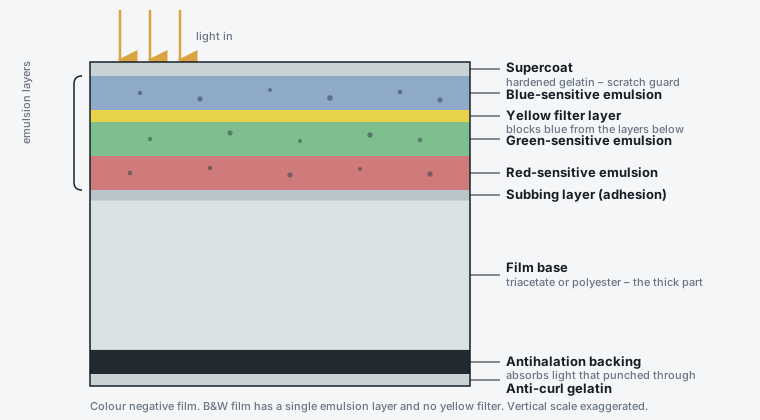
A colour-negative film in cross-section. Black-and-white film collapses the three coloured emulsion layers into one. Not to scale – the base is by far the thickest part.
The base: acetate vs polyester
The support you can actually feel, and it matters in practice:
Cellulose triacetate (TAC / “acetate”) tears cleanly, is easy to cut, and is what almost every 35 mm still film is coated on today, Kodak and Ilford included. Its weakness is “vinegar syndrome”: over decades, in warm damp storage, acetate slowly hydrolyses, smells of vinegar, shrinks and becomes brittle. This is a serious archival problem for old movie prints.
Polyester (PET, sold as ESTAR by Kodak) is far more stable and much stronger, so strong that if the film jams it is the camera that gives, not the film. It is used for almost all sheet film, for microfilm, for cine print stock, for aerial and surveillance film (and so for the many 35 mm films respooled from that stock, such as Rollei Retro and Superpan or JCH StreetPan), and for a few specialist 35 mm films (Rollei Infrared, CineStill’s black-and-white). Polyester also “pipes” light down its length, so it fogs more easily from a leader left in the sun.
Fun fact
The “35 mm” in 35 mm film is the width of the strip, including the sprocket holes – a standard Thomas Edison’s lab settled on around 1892 by slitting 70 mm Kodak roll film down the middle. The still-photography cartridge (Kodak’s 135 format, 1934) simply borrowed the movie industry’s film stock. That is why your photos are 24×36 mm: it is two frames of movie film (each 18×24 mm) laid side by side and run through the camera horizontally.
What is actually sensitive to light
Suspended in the emulsion gelatin are crystals (“grains”) of silver halide – silver bromide, silver chloride, silver iodide, or mixtures. They are tiny: from about 0.05 µm in a very slow, fine film up to ~2 µm in a fast one. A single 35 mm frame holds anywhere from hundreds of millions to tens of billions of them, depending on how fine the film is.
Silver halide is the whole trick because of one property: when a photon is absorbed by a crystal, it can knock an electron loose, and that electron can reduce a silver ion to a single neutral silver atom. Get a few of those atoms clustered together on one spot of the crystal (roughly 4+ atoms) and you have a stable development centre.
That cluster is the latent image. It is utterly invisible – a few atoms on a crystal of a billion – and it is all that a correctly exposed film carries when it comes out of the camera. Everything after this is amplification.
The three-step trick
Key idea
Photography works because development is a chemical amplifier with enormous gain. A crystal with a latent-image speck is developed completely to silver; an identical crystal without one is left alone. That difference – a few atoms – is turned into a difference of ~10⁸–10¹⁰ atoms of visible silver. Exposure writes the message in invisible ink; development is the lamp you hold it up to.
Exposure. Light forms latent-image specks on the crystals that received enough photons. More light on a region → more crystals there carry a speck.
Development. A mild reducing agent (the developer) converts entire crystals to black metallic silver – but only crystals that carry a latent-image speck, and only within the time allowed. Unexposed crystals develop far more slowly and are left behind. The image is now visible, but the film is still full of undeveloped, still-light-sensitive halide.
Fixing. A fixer (sodium or ammonium thiosulfate, “hypo”) dissolves the remaining silver halide into soluble complexes that wash out. What is left is a stable image made of silver (B&W) or dye (colour), and the film is no longer sensitive to light.
A wash removes residual chemistry; drying finishes the job. In colour and in B&W the skeleton is the same – colour just adds dye-forming reactions during development and a bleach step that removes the silver again afterwards, leaving only dye (see C-41: colour negative processing).
Negative vs positive
In a negative film, developed silver/dye is dense where the scene was bright. The processed film is a tonal and (for colour) colour inversion of the scene. You get a positive by printing or scanning-and-inverting it.
In a reversal (“slide”, “transparency”) film, extra processing steps flip it: the first developer makes a negative silver image, that silver is bleached away, the remaining halide is fogged and developed, and you end up with a positive you can hold up to the light. See Colour reversal (slide) film.
Why any of this matters to a photographer
Every layer above is a lever the film designer pulled, and those choices are exactly what you are choosing between when you pick a film:
Design choice |
What you see in the picture |
|---|---|
Crystal size and size spread |
Film speed and grain – bigger crystals catch light faster but are coarser. |
Crystal shape (cubic vs flat “T-grain”) |
Sharpness and grain at a given speed – flat grains show more surface to the light. |
Spectral sensitisation dyes |
How the film renders colours as tones (B&W) or how accurate/biased colour is. |
Number and contrast of emulsion layers |
Exposure latitude and the shape of the characteristic curve. |
Dye couplers (colour only) |
The signature palette – Portra’s skin tones, Velvia’s punch. |
The rest of the Foundations and Inside the emulsion chapters take these one at a time.
Where to go next
How a photograph forms – the latent image and development in more detail.
Film speed: ASA, DIN, ISO and EI – what the ISO number on the box actually is.
Silver halide: the light-sensitive heart of film – the chemistry of the crystal itself.