Silver halide: the light-sensitive heart of film
Strip away the gelatin, the base and the dyes and every conventional film comes down to one material: silver halide crystals. Their composition, size and surface chemistry decide almost everything measurable about a film.
In short
The light-sensitive salts are silver bromide (AgBr), silver chloride (AgCl) and silver iodide (AgI), almost always as mixed crystals – camera films are AgBr with a few mol-% AgI.
Crystals are grown in gelatin under tight control of temperature, silver/halide ratio and time. Size runs ~0.05–2 µm; bigger crystal = faster + grainier.
Chemical (sulfur/gold) sensitisation after growth creates the surface specks that trap photoelectrons – it can raise speed by several stops without changing size.
Spectral sensitisation with adsorbed dyes extends sensitivity from the native blue- UV out to green, red and infrared. Without it, film “sees” only blue.
Crystal habit – cubic, octahedral, or flat tabular (“T-grain”) – trades grain against sharpness and speed.
Why silver halides
Silver halides sit in a chemical sweet spot:
They are photoconductive semiconductors with a band gap that blue light can bridge – a photon of ~450 nm or shorter frees an electron.
The lattice contains mobile interstitial Ag⁺ ions (Frenkel defects) that can drift to a trapped electron and be neutralised into a silver atom.
The resulting silver speck is a stable catalyst for chemical reduction – the basis of development amplification (see How a photograph forms).
They are almost insoluble in water but form soluble complexes with thiosulfate, so the undeveloped crystals can be fixed out cleanly.
No other cheap, coatable material does all of this at once. Attempts at “silverless” photography (diazo, vesicular, electrophotography) all trade away sensitivity.
Bromide vs iodide vs chloride
Halide |
Where used |
Behaviour |
|---|---|---|
AgCl |
Photographic paper, some print films, X-ray |
Low intrinsic speed, develops fast, low fog. Too slow for camera film. |
AgBr |
The backbone of nearly all camera film |
Good speed, good tone. Native sensitivity peaks ~450 nm (blue). |
AgI (as a few % in AgBr) |
Camera films, especially fast ones |
Distorts the lattice, deepens electron traps, boosts speed and dye adsorption. Pure AgI is almost insensitive and hard to fix, so it is only ever a minor component. |
AgBrCl / AgClBr mixes |
Rapid-processing and machine print films |
Tunable speed/contrast/development-rate. |
Fun fact
Every film starts with far more silver than the finished picture keeps: a 36-exposure roll is coated with on the order of 100–300 mg of silver, most of which is dissolved out in the fixer (in colour film, all of the image silver is bleached and fixed away, leaving only dye). Around 1999–2000, photographic and X-ray film consumed about a quarter of the world’s silver demand (roughly 6,700 tonnes in 2000); by 2013 digital had cut that below a tenth. Spent fixer is still collected and refined for silver recovery.
Growing the crystals: precipitation
The emulsion is made by controlled double-jet precipitation: solutions of silver nitrate and an alkali halide are run simultaneously into warm stirred gelatin. The operator controls:
pAg / pBr (the silver-to-halide ratio in solution) – steers crystal habit.
Temperature and time – set the size; longer “ripening” grows bigger crystals as small ones dissolve and redeposit onto large ones (Ostwald ripening).
Gelatin – acts as a growth-restraining and protective colloid, and (in “active” gelatins) supplies trace sulfur compounds for later sensitisation.
The result is an emulsion: a suspension of crystals with a particular mean size and a particular spread of sizes. A narrow spread → high contrast (all crystals cross the exposure threshold together). A deliberately wide or multi-modal spread → lower contrast and wide latitude (different crystals respond at different exposures). Many films blend two or three separately grown emulsions to shape the characteristic curve.
Chemical sensitisation
Fresh from precipitation, a crystal is a poor photographic material – most photoelectrons recombine before an Ag⁺ arrives. After growth, the emulsion is “digested” with tiny amounts of:
Sulfur compounds (labile thiosulfates) → silver sulfide (Ag₂S) specks on the surface that act as deep electron traps and nucleation sites.
Gold salts → gold, or gold-silver specks, even more effective; “sulfur-plus-gold” sensitisation is standard for fast films.
Reduction sensitisation (mild reducing agents, or low-pAg digestion) → small silver clusters (“R-centres”).
Done well this raises speed several stops with no change in grain size. Done too far it produces fog – specks big enough to trigger development with no exposure at all. The art is stopping just short.
Key idea
Two films with the same grain size can differ by two or more stops in speed purely through sensitisation chemistry. This is why “modern ISO 400 looks like old ISO 100” – decades of refinement in surface chemistry and crystal engineering, not a change in the physics.
Spectral sensitisation: teaching film to see colour
An unsensitised AgBr crystal absorbs only blue and UV (< ~500 nm). Early films were like this – “blue-sensitive” – which is why 19th-century skies are always white and red barns print black.
In 1873 Hermann Vogel discovered that certain dyes adsorbed onto the crystal surface let it respond to the wavelengths the dye absorbs, by injecting an electron into the crystal’s conduction band when the dye is excited. Choosing the dye chooses the sensitivity band:
Class |
Sensitive to |
Notes |
|---|---|---|
Blue-sensitive (unsensitised) |
blue + UV |
Litho films, some technical films, cheap X-ray. “Ordinary” plates. |
Orthochromatic |
blue + green (not red) |
Can be handled under a red safelight. Renders reds dark, skin tones heavy; still made (Ilford Ortho Plus, Rollei Ortho 25). |
Panchromatic |
the whole visible spectrum |
The norm for B&W camera film since the 1920s. Must be developed in total darkness. |
Infrared / extended-red |
visible + near-IR to ~750–900 nm |
Rollei Infrared 400, (discontinued Kodak HIE, Ilford SFX is “extended red”). Needs an opaque-red filter for the classic look. |
Colour film uses this deliberately: three emulsion layers, spectrally sensitised to blue, green and red respectively, are the colour-separation channels (see How colour film works).
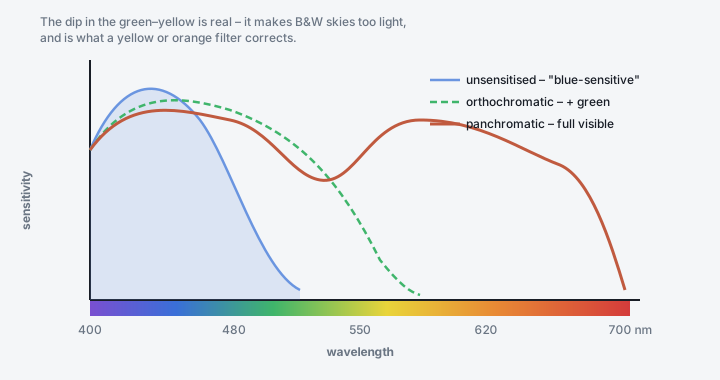
Adding sensitising dyes extends a crystal’s native blue-only response across the spectrum. The green–yellow dip in many panchromatic films is why a yellow filter “corrects” B&W tonality toward what the eye expects.
Crystal habit: cubic vs tabular
The shape of the crystal is a major modern design lever:
Cubic / cubo-octahedral grains – the traditional 3-D “chunk”. Simple, robust, used in classic emulsions (Tri-X, HP5 Plus, Fomapan).
Tabular (“T-grain”, Kodak’s trademark; “Core-Shell”/“Delta” at Ilford) – flat hexagonal or triangular platelets, high aspect ratio, that lie flat in the coating. A tabular grain presents a large surface area to the light for its silver content, which means:
more efficient light capture → speed for less silver → less grain at a given speed;
the flat plane holds spectral-sensitising dye better → better colour and speed;
less sideways light scatter in a thinner coating → more sharpness;
trade-offs: more sensitive to development conditions, a “cleaner/clinical” grain some photographers dislike, and reciprocity behaviour that differs from cubic films.
T-grain (Kodak T-Max, Portra, Ektar; Ilford Delta) vs cubic (Tri-X, HP5+) is one of the real dividing lines in the “why do films look different” question.
Where to go next
Grain, granularity and sharpness – from crystal size to the grain you see in a print.
Spectral sensitivity: what colours the film can see – the tonal consequences of what the film can see.
The characteristic curve – how the crystal-size distribution becomes a curve shape.