Grain, granularity and sharpness
“Grain” is the texture you see in a film image. It is not a defect – it is the film’s information carrier made visible – but it is the single property photographers argue about most.
In short
The grains (silver-halide crystals) are far too small to see. What you see is granularity: the random clumping of developed silver into a mottled pattern.
Bigger, faster crystals → coarser granularity. Speed and grain trade off directly.
B&W and slide films quote RMS granularity (a “diffuse RMS × 1000” number): ~8 is very fine, ~10–13 moderate, 17+ coarse. Kodak’s colour negative films now use a different, non-comparable measure (Print Grain Index).
Graininess is the subjective impression, and it depends on enlargement – a 35 mm frame blown up to A3 shows far more grain than a 6×7 negative to the same size.
Colour film has no silver grain in the final image; its “grain” is dye clouds formed around the (now bleached-out) developed crystals.
Three words that get confused
Term |
Meaning |
|---|---|
Grain |
The individual silver-halide crystal (before) / silver filament or dye cloud (after). ~0.2–2 µm. Invisible individually. |
Granularity |
An objective measurement of density fluctuation across a uniformly exposed area – the physical clumpiness. Quoted as RMS granularity (root-mean-square of the density variation). |
Graininess |
The subjective sensation of grain when you look at the print or scan. A function of granularity and magnification, viewing distance, contrast, and the tone (grain shows most in smooth midtones like skies and skin). |
Why speed and grain trade off
A faster film needs fewer photons per crystal to record a latent-image speck. The two ways to get there both increase granularity:
Bigger crystals – a larger target catches more photons and produces a larger blob of developed silver. Fewer, larger blobs per unit area = coarser texture and more statistical “noise” between areas.
Fewer photons per grain at the speed point means each patch of film is built from a smaller number of developed grains, so Poisson statistics make the density noisier – the same reason a photo taken with few photons looks noisy on a digital sensor.
Key idea
Grain is photon shot noise made permanent. A slow film averages many photons into each grain and packs many grains per square millimetre, so its rendering of a smooth tone is smooth. A fast film does neither. No amount of clever chemistry fully escapes this – it only pushes the curve, which is what T-grain technology did.
Modern tabular-grain emulsions (T-Max, Delta, Portra, Ektar) win back roughly a stop of the grain penalty by presenting more light-catching surface per unit of silver (see Silver halide: the light-sensitive heart of film). That is why T-Max 400 is finer-grained than Tri-X 400 despite the same nominal speed – and why some photographers still prefer Tri-X’s chunkier, “organic” cubic grain.
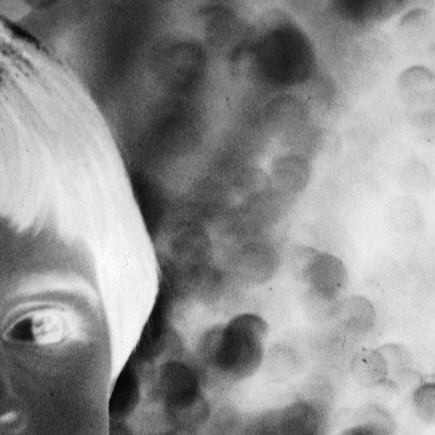
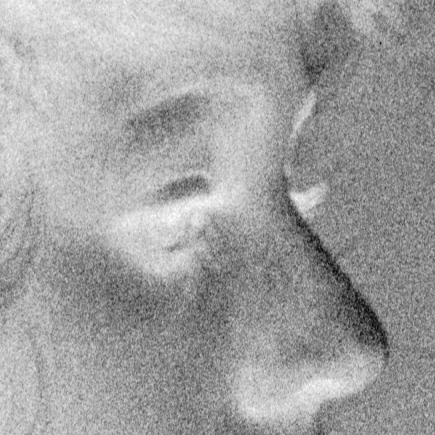
Same scene, slow vs fast film – the speed/grain trade-off made visible. [Photos: user "Smial", CC BY-SA 2.0 DE]
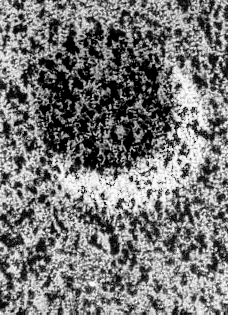
A developed emulsion under the microscope: the image is built from irregular clumps of metallic silver filaments. This clumping – not the individual crystals – is what your eye reads as grain. [Photo: Jean-Jacques MILAN, CC BY-SA 3.0]
The numbers on the datasheet
RMS granularity and Print Grain Index
RMS granularity is the standard deviation of density, measured through a 48 µm circular aperture on an area of density 1.0, multiplied by 1000. Rough reading of the number: ~8 or below is extremely fine, 9–12 fine-to-moderate, 13–17 noticeable, 18+ coarse.
It is still quoted for black-and-white and slide films:
Film |
RMS |
|
|---|---|---|
Fuji Provia 100F / Velvia 100 |
8 |
extremely fine (slide) |
Fuji Velvia 50 |
9 |
extremely fine (slide) |
Kodak T-Max 100 |
~8 |
extremely fine (B&W) |
Kodak T-Max 400 |
~10 |
fine (B&W) |
Kodak Tri-X 400 |
17 |
noticeable (B&W) |
Kodak T-Max P3200 |
~18+ |
coarse (B&W, a push film) |
Kodak’s colour negative films (Ektar, Portra, Gold) no longer carry an RMS number. Kodak replaced it with a Print Grain Index (PGI): observers rate whether they can see grain in a print at a given enlargement, and the film’s PGI is the enlargement at which grain becomes just visible. It is a more meaningful figure for a photographer but cannot be compared to an RMS number or across brands. On that scale Ektar 100 is the finest current colour negative, with Portra 160 and 400 close behind and Portra 800 coarser.
Ilford publishes a word rating (“extremely fine”, “medium”) plus print-grain and MTF graphs rather than a single RMS number, so cross-brand comparison always needs care.
Resolving power and MTF
Resolving power – line pairs per millimetre (lp/mm) the film can just distinguish, measured against a low- and a high-contrast test chart. Slow films reach 100–200 lp/mm; fast films 50–100. It is a crude single number.
MTF (Modulation Transfer Function) – the film’s contrast response versus spatial frequency, plotted as a curve. A film whose MTF stays above 100% at low frequencies (many do, from edge effects in development) looks sharper than a flat one even at the same limiting resolution. This is acutance – perceived edge crispness – and it is why Rodinal-developed film “looks sharp” despite visible grain.
Fun fact
Adjacency (edge) effects actively boost sharpness. At a dark/light boundary, developer is exhausted on the dense side and fresh on the thin side, so a thin dark line and a bright light line form right at the edge – a built-in “unsharp mask”. Compensating and high-acutance developers, and long stand development, exaggerate this. Digital sharpening is imitating a 100-year-old chemical accident.
What changes grain after the film is chosen
Enlargement. The dominant factor. Grain scales with magnification. A 35 mm frame (24×36 mm) to A4 is ~8×; the same print from 6×6 medium format is ~3.5×, so medium-format grain of a nominally grainier film can look finer.
Development. More active developers, higher temperature, longer time and vigorous agitation all increase grain (and contrast). Fine-grain developers (D-76/ID-11 stock, Perceptol, XTOL) use a mild silver solvent to erode crystal edges – finer grain, ~⅓–1 stop speed loss. Two-bath and compensating developers keep highlight grain down.
Exposure. Underexposing then pushing puts the image on the noisy toe and amplifies grain. Overexposing negative film by a stop and printing/scanning down generally gives finer apparent grain and smoother shadows.
Push processing. Extra development to compensate for underexposure → markedly more grain and contrast. A native fast film beats a pushed slow one for smoothness.
Scanning. A sharp scanner and aggressive sharpening can turn mild granularity into aggressive “grain aliasing”. Grain-reduction scan modes (Digital ICE’s GEM, Neat Image, Lightroom) trade grain for smearing. Wet prints render grain more gently than most scanners.
Grain in colour film
There are no silver grains in a finished colour image – the silver is bleached out in processing (see C-41: colour negative processing). What remains is dye, formed as clouds around where each developed crystal used to be. Colour “grain” is therefore:
Dye-cloud size – set by the original crystal size, so the speed/grain trade-off still holds.
Chromatic – it has colour speckle, most visible in the blue-sensitive layer (top layer, coarsest crystals, worst signal-to-noise), which is why underexposed colour shadows go grainy and blotchy-cyan/magenta.
Layered – three layers of grain overlaid, partially decorrelated, which can look smoother or noisier than an equivalent B&W film depending on the tone.
Chromogenic B&W films (Ilford XP2 Super, Kodak BW400CN) are the interesting hybrid: C-41 process, dye image, no silver grain → extremely smooth, with grain that decreases with overexposure (opposite to normal B&W).
Where to go next
Silver halide: the light-sensitive heart of film – crystal habit and why T-grain changed the trade-off.
The characteristic curve – grain, contrast and the toe.
Black-and-white development – developer choice and grain.