Black-and-white development
B&W is the one process you can genuinely do on a kitchen counter with a changing bag, a tank and three bottles. It’s also where your choices – which developer, how dilute, how long, how much agitation – visibly shape the negative.
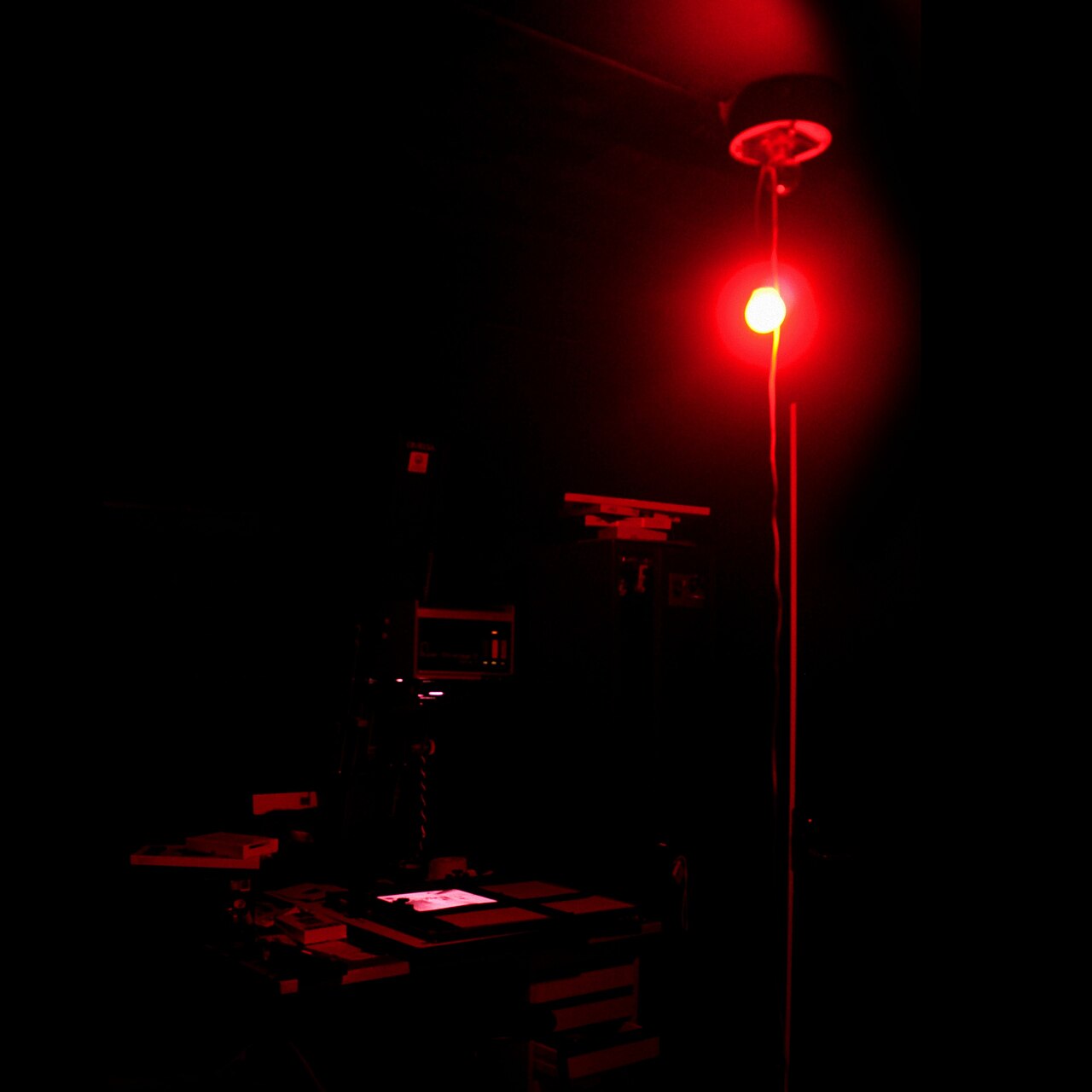
A home darkroom. Development itself needs only a daylight tank and a dark bag to load it; a full darkroom like this is for the printing stage. [Photo: Tatu Kosonen, CC BY-SA 4.0]
In short
Steps: develop → stop → fix → wash → (wetting agent) → dry.
Only development is critical on time/temperature; stop and fix are forgiving.
Developer families: general-purpose (D-76/ID-11, Xtol), one-shot liquids (HC-110, Ilfotec), high-acutance (Rodinal), fine-grain (Perceptol), speed-increasing (DD-X, Microphen), and monobath (develop+fix in one, e.g. Cinestill DF96).
Temperature 20 °C is the reference; time scales ~ ±factor per degree.
Agitation builds contrast and evenness; more = more contrast, less = compensating effects.
Look up times in a developer’s datasheet or the Massive Dev Chart.
The chemistry, step by step
Step |
Time |
Temp |
Purpose |
|---|---|---|---|
Pre-soak (optional) |
1–3 min |
match dev |
even out temperature, swell emulsion, remove anti-halation dye (cleaner fixer). Some developers (Xtol) say skip it. |
Developer |
4–14 min (film/developer specific) |
20 °C ±0.5 (or the stated temp) |
the critical step. Converts exposed crystals to silver. Time/temp/agitation set contrast. |
Stop bath |
30–60 s |
~20 °C |
dilute acetic acid (or plain water × 2–3 changes). Halts development, protects fixer. |
Fixer |
2–5 min (rapid) / 5–10 min (older) |
18–24 °C |
dissolves undeveloped halide. Test with a clip test (a film leader clears in t seconds → fix for 2×t). Fixer is reusable; track capacity. |
Wash |
5–20 min |
~20 °C |
Ilford method: fill+invert 5×, dump; 10×; 20×. Or running water. Poor washing → brown stain and fading over years. |
Hypo clear (optional) |
1–2 min |
~20 °C |
cuts wash time and improves permanence, especially on fibre-base prints; nice for film too. |
Wetting agent |
30 s |
~20 °C |
a drop of Photo-Flo / Ilfotol in distilled water → no drying marks. |
Dry |
1–3 h |
dust-free |
hang weighted in a bathroom run hot for steam first (settles dust). |
Everything after the developer can be done in room light once the film is in the tank. Loading the film onto the reel is the only true-darkness part (changing bag or dark room).
Temperature and time
20 °C (68 °F) is the classic reference. If your developer is warmer or cooler, adjust time. Rough guide (developer-dependent – use a real chart):
Temp |
18 °C |
20 °C |
22 °C |
24 °C |
|---|---|---|---|---|
Time factor |
×1.25 |
×1.00 |
×0.80 |
×0.65 |
Keep all baths within ~2 °C of each other to avoid reticulation (a cracked-mud grain pattern from thermal shock – rare with modern hardened emulsions but real). In summer, work at 24 °C with shorter times rather than fighting to cool everything to 20.
Agitation
Agitation replenishes developer at the emulsion and clears exhausted by-products.
Standard: invert the tank gently ~4 times per 30 s for the first 30 s, then 4 inversions every minute. Tap the tank to dislodge bubbles.
More agitation → more contrast, more even, slightly more grain.
Less / intermittent (“semi-stand”: agitate once at start and once at half-time) → lower contrast, strong edge effects (acutance), highlights that “compensate” (don’t run away). Risk: bromide drag – streaks below dense areas, especially off sprocket holes.
Stand development (Rodinal 1+100, 1 hour, agitate only at the start) → extreme compensation and sharpness, real risk of unevenness. A look, not a default.
Developer families
Developer |
Type |
Character & use |
|---|---|---|
Kodak D-76 / Ilford ID-11 |
powder, general-purpose |
The reference standard. Stock = balanced; 1+1 = sharper, finer grain, one- shot; 1+3 = sharper still. If you learn one developer, learn this. ~⅓ stop speed at 1+1. |
Kodak Xtol / XDEV, Adox XT-3, Ilford Ilfotec DD-X |
powder / liquid, fine-grain + speed |
Modern ascorbate developer: finest grain and full box speed, very clean, great with T-grain films. Kodak now sells it as XDEV (5 L only); Adox XT-3 is a near-identical clone in smaller sizes. DD-X (Ilford, liquid) is similar and excellent for HP5/Delta and pushing. |
Kodak HC-110 / Ilford Ilfotec HC / LC29 |
syrup/liquid concentrate |
Long shelf life (HC-110 syrup lasts years), highly dilutable, one-shot, convenient. “Dilution B” (1+31) with Tri-X is a classic. Slightly more grain than D-76. |
Rodinal / Adox Adonal / R09 |
liquid concentrate, high-acutance |
Ancient (1891), nearly immortal shelf life, 1+25 to 1+100. Sharp, crisp edges, pronounced but tight grain. Superb on slow films (Pan F, FP4, Fomapan 100); harsh on fast films. The “grain and bite” developer. |
Ilford Perceptol / Kodak Microdol-X |
powder, extra-fine-grain |
Solvent developer – smallest grain, at ~1 stop speed loss. For maximum smoothness on 100–400 films, or taming Tri-X. |
Ilford Microphen / Kodak DK-50 |
powder, speed-increasing |
Phenidone-based, buys ~⅔–1 stop. The push developer for HP5/Delta 3200. |
Cinestill DF96 / Bellini Monobath / New55 R5 |
monobath (develop + fix in one) |
One bath, one step, ~3–6 min, temperature-flexible (20–27 °C). Develops and fixes simultaneously. Dead easy, reusable ~16 rolls, slightly less control over contrast. The best “just get me a negative” option for beginners. |
Caffenol (coffee + washing soda + vitamin C) |
DIY |
Genuinely works – a home-brew phenol developer. Grainy, characterful, cheap, smelly. A fun experiment, not an archival choice. |
Two-bath (Diafine, Barry Thornton, D-23 divided) |
powder, compensating |
Bath A soaks in, Bath B activates. Time- and temperature-insensitive, automatic highlight compensation, one speed rating per film (Diafine rates Tri-X at ~1250). |
Key idea
The developer is a second exposure decision. The same HP5 Plus negative, shot identically, is a different photograph in Perceptol (smooth, lower contrast, −1 stop) vs Rodinal (sharp, grainy, punchy) vs DD-X (clean, full speed). Pick the developer for the look, then the time for the contrast.
A first-timer’s recipe
Kit: changing bag, developing tank + reel, thermometer, 3 measuring cylinders, timer, 3 storage bottles.
In the changing bag: open cassette (or use a leader retriever), trim leader, load film onto reel, into tank, lid on. Now you’re in daylight.
Mix: developer (e.g. Ilfosol 3 1+9, or DF96 monobath) at 20 °C.
Develop: pour in, start timer, agitate 30 s, then 4 inversions/min. (DF96: agitate first minute continuously, then 10 s/min, ~4 min.)
Stop: water rinse ×3 (or stop bath 30 s). (Skip if monobath.)
Fix: rapid fixer 3–5 min, agitate first 30 s then occasionally. (Skip if monobath – it fixed as it developed.)
Wash: Ilford method (5/10/20 inversions) or 10 min running water.
Rinse in wetting agent 30 s.
Hang to dry 1–2 h, then cut into strips of 5–6 and sleeve.
Troubleshooting
Symptom |
Likely cause |
|---|---|
Thin, low-contrast negatives |
underdeveloped (time/temp low), exhausted developer, or underexposed |
Dense, hard-to-scan negatives, blown highlights |
overdeveloped, or overexposed, or agitation too vigorous |
Clear film, no images at all |
fixed before developing / developer was actually fixer / no exposure (camera fault) |
Milky / cloudy base |
underfixed or exhausted fixer – refix in fresh fixer, rewash |
Streaks below sprocket holes / dense areas |
bromide drag – too little agitation with an active developer |
Cracked-mud grain texture |
reticulation – large temperature jump between baths |
Drying marks / spots |
no wetting agent, or hard water – final rinse in distilled water + Photo-Flo |
Crescent-moon marks |
film kinked while loading the reel |
Where to go next
Pushing and pulling film – changing development time on purpose.
Scanning and printing – getting the image off the negative.
Grain, granularity and sharpness – how developer choice moves grain and sharpness.