Filters for film
Digital fixes colour and contrast after the fact. On film, a lot of that work happens in front of the lens – and some of it (a polariser’s glare removal, true ND) can’t be done any other way.
In short
B&W contrast filters (yellow → orange → red, green, blue): each lightens its own colour and darkens the opposite. The core creative control for B&W.
Colour-correction filters (85 orange, 80 blue, 81/82 warm/cool, CC/FL): match the film’s fixed white balance to the light. Essential for tungsten film in daylight and vice versa.
Polariser: cuts reflections and glare, deepens skies – irreplaceable, costs ~1½–2 stops.
ND / grad ND: reduce light overall / hold back a bright sky. Same as digital.
Filter factor = extra exposure needed. TTL meters compensate mostly automatically; deep red on B&W still often needs +½–1 stop by hand.
Black-and-white contrast filters
Panchromatic B&W renders blue too light and green a bit dark (see Spectral sensitivity: what colours the film can see). A coloured filter passes its own colour (that colour → lighter in the print) and absorbs the complementary colour (→ darker).
Filter |
Factor |
Effect |
When to use |
|---|---|---|---|
Yellow (Y2 / #8) |
⅔–1 stop |
sky slightly darker, clouds visible, tonality “as the eye sees” |
the default outdoor B&W filter; leave it on |
Yellow-green (#11) |
1–1⅓ |
foliage lighter and separated, skies natural, flattering skin |
portraits outdoors, landscapes with lots of green |
Orange (#21 / G) |
1½–2 |
dark sky, dramatic clouds, haze cut, freckles/blemishes suppressed |
landscape drama, architecture, coastal haze, male portraits |
Red (#25) |
2½–3 |
near-black sky, brilliant white clouds, very dark foliage, strong haze cut |
bold landscape (“the Ansel sky”), infrared-ish look with SFX/extended-red film |
Deep red (#29) |
3–4 |
extreme version of the above; near-monochromatic |
dramatic effect; required for some IR films |
Green (#58) |
2½–3 |
foliage much lighter, red flowers/lips darker, skies a touch lighter |
lightening a forest scene; deliberate “botanical” look |
Blue (#47) |
2–3 |
increases haze and atmosphere, lightens sky, darkens reds/yellows |
period/atmospheric effect (rare) |
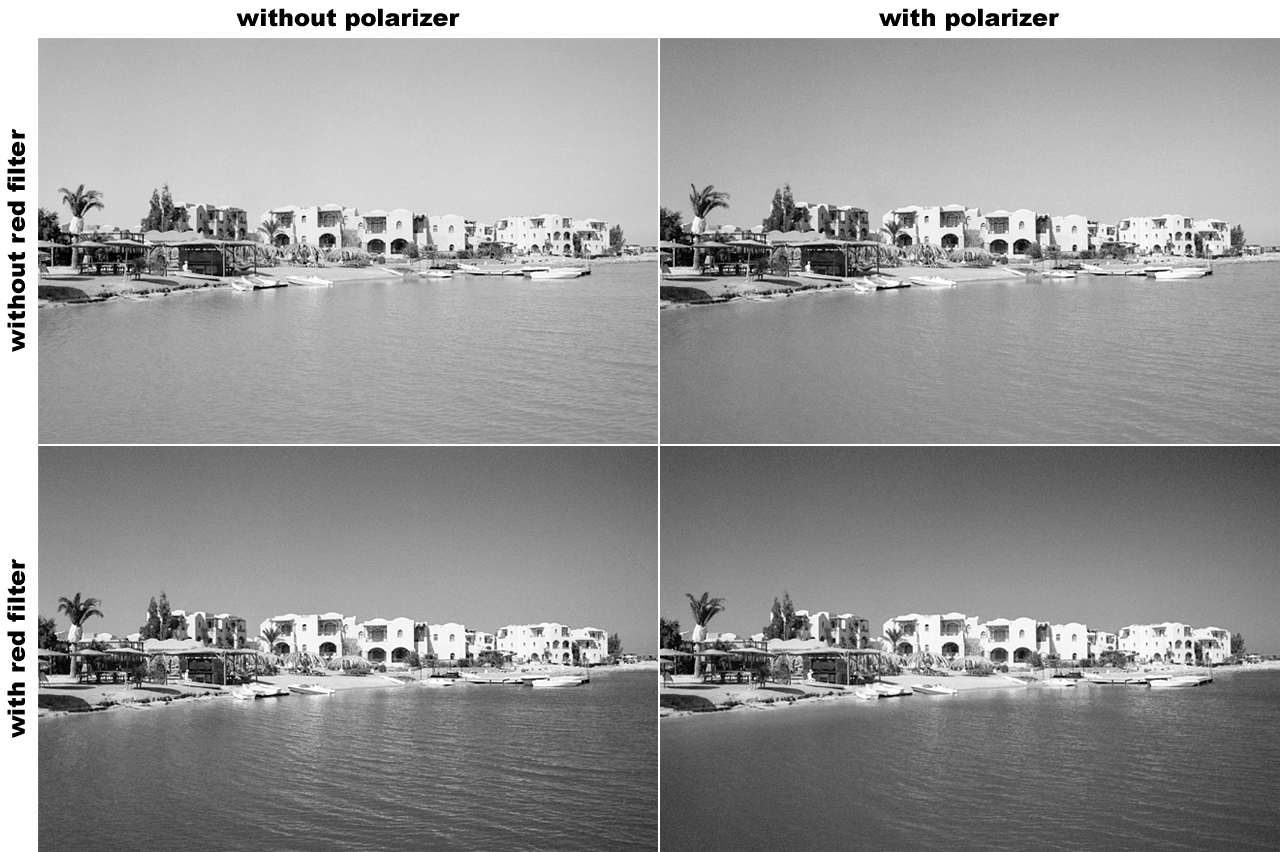
The same scene, no filter → polariser → red filter. Each darkens the blue sky and water and lifts the clouds and foreground out. [Photo: Blueshade, CC BY-SA 1.0]
Key idea
“Filter to separate what would otherwise be the same grey.” A red apple on green leaves can render as identical mid-greys on panchromatic B&W. A green filter darkens the apple; a red filter darkens the leaves. Pick the one that puts your subject where you want it against its background.
Colour-correction filters
Colour film has a fixed white balance – daylight (5500 K) or tungsten (3200 K). Shoot under the wrong light and you get a cast the film cannot self-correct.
Filter |
Colour |
Factor |
Use |
|---|---|---|---|
85 / 85B |
amber |
⅔ stop |
tungsten film (e.g. CineStill 800T) in daylight → neutral. “85B” for 3200 K film. |
80A / 80B |
deep blue |
2 / 1⅔ stops |
daylight film under tungsten bulbs → neutral (costs a lot of light; often skipped in favour of correcting the scan) |
81A / 81B / 81C |
pale amber |
⅓–⅔ |
gentle warming – open shade, overcast, cool morning light; flatters skin |
82A / 82B |
pale blue |
⅓–⅔ |
gentle cooling – warm indoor light, sunset overspill |
FL-D / FL-W |
magenta |
1 |
kill the green cast of fluorescent tubes on daylight film |
CC (colour compensating) gels (e.g. CC30M) |
various |
varies |
fine colour tuning; correcting reciprocity colour shifts on long exposures; mixed-light fixes |
For negative film, mild casts are easy to fix in scanning, so 81/82-series filters are often skipped. For slide film, which is the finished image, correction filters matter far more – a tungsten-lit slide on daylight film is just orange.
Polariser
A circular polariser (CPL – use circular, not linear, on any camera with a beam- splitter meter or AF):
Removes reflections from glass, water, wet leaves, painted surfaces (rotate to taste; strongest at ~35° to the surface).
Deepens blue sky and boosts cloud contrast – strongest at 90° to the sun, nothing at 0/180°. On colour film this is the classic saturated-sky effect; on B&W it works like a mild neutral version of a coloured filter.
Cuts atmospheric haze and increases overall saturation by removing scattered glare.
Costs ~1⅓–2 stops. TTL meters handle it. Watch for uneven skies with wide lenses (the polarisation angle varies across the frame).
Nothing in software reproduces glare removal – the polariser is a permanent bag item.
Neutral density (ND) and graduated ND
Solid ND (ND2/0.3/1-stop up to ND1000/10-stop): cut light to allow wide apertures in bright sun (portraits at f/1.4 at 1/1000 cap) or long exposures (moving water, crowds vanishing). No colour or contrast change if it’s a good filter; cheap NDs add casts.
Graduated ND (soft/hard edge, usually 2–3 stops): darkens a bright sky to fit it within slide film’s tiny latitude, or to balance a landscape without needing to develop for it. Less needed with negative film’s wide latitude, still useful for slide.
Reciprocity: once ND pushes you past ~1 s, factor in reciprocity failure on top of the ND.
Filter factors and metering
Filter factor = the exposure multiplier the filter needs (×2 = +1 stop, ×4 = +2, ×8 = +3).
TTL (through-the-lens) meter: reads the already-filtered light and compensates automatically – mostly. Silicon and older CdS meters aren’t equally sensitive across the spectrum, so a deep red (#25/#29) on B&W often still needs +½ to +1 stop added by hand; a polariser and mild colour filters are fine.
Handheld meter: apply the full published factor yourself (meter, then open up by the factor).
Stacking filters: add the factors in stops (a 2-stop ND + a 1-stop yellow = +3).
Fun fact
Ansel Adams’s Moonrise, Hernandez and Monolith, the Face of Half Dome both owe their black skies to a filter – a #29 deep red on Monolith, chosen on the spot when he “visualised” the sky far darker than it looked. He later called using the red filter there the moment he understood he could photograph what he felt rather than what was in front of him. On film, the filter is part of the composition.
Where to go next
Spectral sensitivity: what colours the film can see – why the B&W filters work.
Reciprocity failure – the long-exposure penalty ND filters trigger.
Specialty and oddball films – filters for IR and redscale.