Storing film, expiry and airport X-rays
Film is a perishable chemical product. It degrades with heat, time, humidity and radiation – slowly if you’re careful, fast if you leave it on a sunny dashboard.
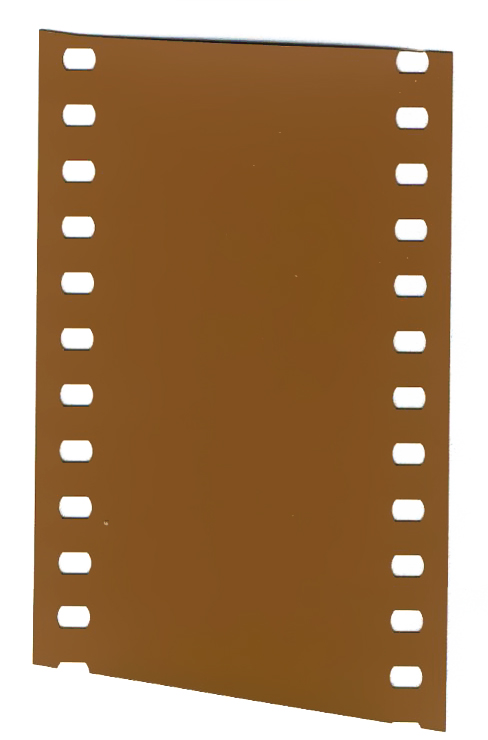
Undeveloped colour negative – light-sensitive, latent-image-bearing, and at its most fragile in this state. Keep it cool and develop it promptly. [Photo: Jay Holben, CC BY-SA 3.0]
In short
Unexposed film: fridge (~5 °C) for months, freezer (−18 °C) for years. Seal against moisture; let it reach room temperature before opening (1 h fridge, 3+ h freezer) to avoid condensation.
Expiry date ≈ 2 years after manufacture, and is conservative. Cold-stored film is good far beyond it. Warm-stored film can be dead before it.
Expired film loses speed (~1 stop per decade, more for fast/colour film), gains fog and grain, and colour shifts (usually toward magenta/green). Overexpose and embrace it.
Exposed, undeveloped film is the most fragile state – develop within weeks, keep cool, don’t fly with it more than you must.
Airport X-ray: old cabin-bag machines are mostly fine for ISO ≤ 400 in a single pass but cumulative. CT scanners (new cabin-bag machines) damage all film in one pass – always request a hand check.
Storing unexposed film
Degradation is driven by heat and time. Cold nearly stops the clock.
Where |
Keeps well for |
Notes |
|---|---|---|
Room temp (20 °C), dark |
up to ~expiry, then slow decline |
fine for film you’ll shoot within months; keep away from radiators, attics, cars |
Fridge (2–8 °C) |
1–3 years past expiry easily |
the practical default for a working stash |
Freezer (−18 °C) |
effectively indefinite (10+ years, often much more) |
for bulk buys and discontinued stock; the film industry stores masters this way |
Rules:
Keep it in the original sealed foil/plastic; if opened, use a zip bag with the air pressed out (moisture is the enemy – it causes mottle and fungus).
Warm up before opening. Condensation on cold film ruins it. ~1 hour from fridge, 3–4 hours from freezer, still sealed.
You can re-freeze film that’s been warmed, within reason – a few cycles won’t hurt.
Colour and fast films (ISO 400+, all slide) degrade faster and benefit most from cold. Slow B&W (Pan F, FP4) is hardy.
Expiry dates and expired film
The printed date is roughly “best before” ≈ 2 years after manufacture – a conservative guarantee, not a cliff. What actually happens as film ages:
Speed loss – background fog eats the shadows; rule of thumb ~1 stop per decade past expiry for consumer colour and fast film, less for slow B&W, more if it was stored warm.
Base fog rise – greyer, lower-contrast, muddier shadows.
Grain increase and, in colour, colour crossover – often a magenta or green cast, uneven between shadows and highlights.
Slide film ages worst (casts, fog, speed loss); slow B&W ages best.
Shooting expired film: overexpose to fight the fog –
Age past expiry |
Rate at |
Expect |
|---|---|---|
1–3 years, cold-stored |
box speed |
basically fine |
5–10 years, room temp |
EI ÷ 2 (1 stop over) |
mild fog, slight shift – often pleasant |
15–25 years |
EI ÷ 3–4 (1½–2 stops over) |
visible fog, grain, strong colour shift; a “look” |
unknown / very old fast colour |
EI ÷ 4+, or shoot B&W only |
lottery |
Frozen-since-new expired film can be indistinguishable from fresh decades later – the date matters far less than the storage history.
Heat, humidity, light
Heat is the fast killer: a car in summer (60 °C+) can noticeably age film in a day and cook it in a week. Never leave film – exposed or not – in a hot car, checked luggage in a cargo hold that may bake on the tarmac, or direct sun.
Humidity causes emulsion mottle, sticky rolls and fungus. Silica gel in the bag for humid climates; don’t store film in a damp basement.
Light fogs film only if the cassette/backing is damaged, but a loaded camera left in the sun can get light-piping down the leader (edge fogging), worst on the few 35 mm films built on a clear polyester base (Rollei Infrared, aerial-derived stocks, CineStill BwXX). Load and unload in shade.
Exposed but undeveloped film
This is the most vulnerable state – the latent image slowly regresses (worse in heat, worse for some films like Pan F Plus):
Develop within 1–4 weeks for best results; sooner for fast/pushed film.
If you can’t, refrigerate the exposed rolls (sealed bag, warm up before opening).
Don’t accumulate a shoebox of exposed rolls “for later” – colour shifts and shadow loss are real after months/years.
Airport security: X-ray and CT
Key idea
Never put film in checked luggage. Hold-baggage scanners use a much stronger dose and will fog film, sometimes severely, in one pass. Film travels in your cabin bag, and at the checkpoint you ask for a hand inspection.
Machine |
Effect on film |
|---|---|
Checked-baggage X-ray (CTX / EDS) |
High dose. Fogs all film in one pass. Never use. |
Traditional cabin-bag X-ray (single-energy) |
Low dose. Generally safe for ISO ≤ 400 for a few passes; damage is cumulative (each scan adds fog), and ISO 800+ / pushed / already-exposed film is more vulnerable. On a multi-leg trip the passes add up. |
CT cabin-bag scanners (now common: “you can leave electronics in the bag”) |
Damage all film – including ISO 100 – in a single pass. Rotating high-dose X-ray. Always hand-check. |
Millimetre-wave body scanners |
Radio-frequency, not X-ray. Harmless to film (but don’t walk film you’re carrying through – put it in the tray for a hand check or it goes through the CT). |
Practical travel routine:
Carry film in a clear zip bag, out of canisters/boxes, ready to show.
At the checkpoint, politely ask: “Could I get a hand inspection for my film, please?” In the US, TSA is required by regulation to hand-check photographic film on request. Elsewhere it’s discretionary – usually granted if you’re calm, early and organised; sometimes refused (notably at some EU and UK airports that insist everything goes through the CT).
If hand checks are refused and it’s a CT scanner: a single pass of ISO 100–400 will likely be acceptable (fog, slight contrast loss) but not ideal; do not send ISO 800+, pushed, or valuable/irreplaceable film through – consider mailing it, buying/developing locally, or a different route.
Lead bags just make the operator turn up the power or force a hand search – not recommended with modern machines.
Ask for the hand check before you’re in the X-ray queue with your bag on the belt.
Fun fact
Kodak’s official guidance changed markedly when CT checkpoint scanners rolled out around 2019–2020: for decades the line was “cabin X-ray is fine below ISO 800”, and overnight it became “request a hand check for all film, any speed.” The scanners got better at seeing threats by getting worse for film.
Where to go next
Pushing and pulling film – pushed film is extra X-ray-sensitive.
Black-and-white development – why to develop exposed film promptly.
Discontinued legends – the frozen-stock stashes keeping dead films alive.