FilmLab
A structured, deep-dive guide to 35 mm photographic film: what it is, how a strip of plastic and gelatin turns light into a picture, and what actually separates one film from another.
It is written for someone who already shoots film but has never been told the technical story. What ISO means on a film box. Why slide film is unforgiving. What “the orange mask” is. Why your photos of a sunset came out muddy. Whether Fujifilm 400 is secretly Kodak (it is).
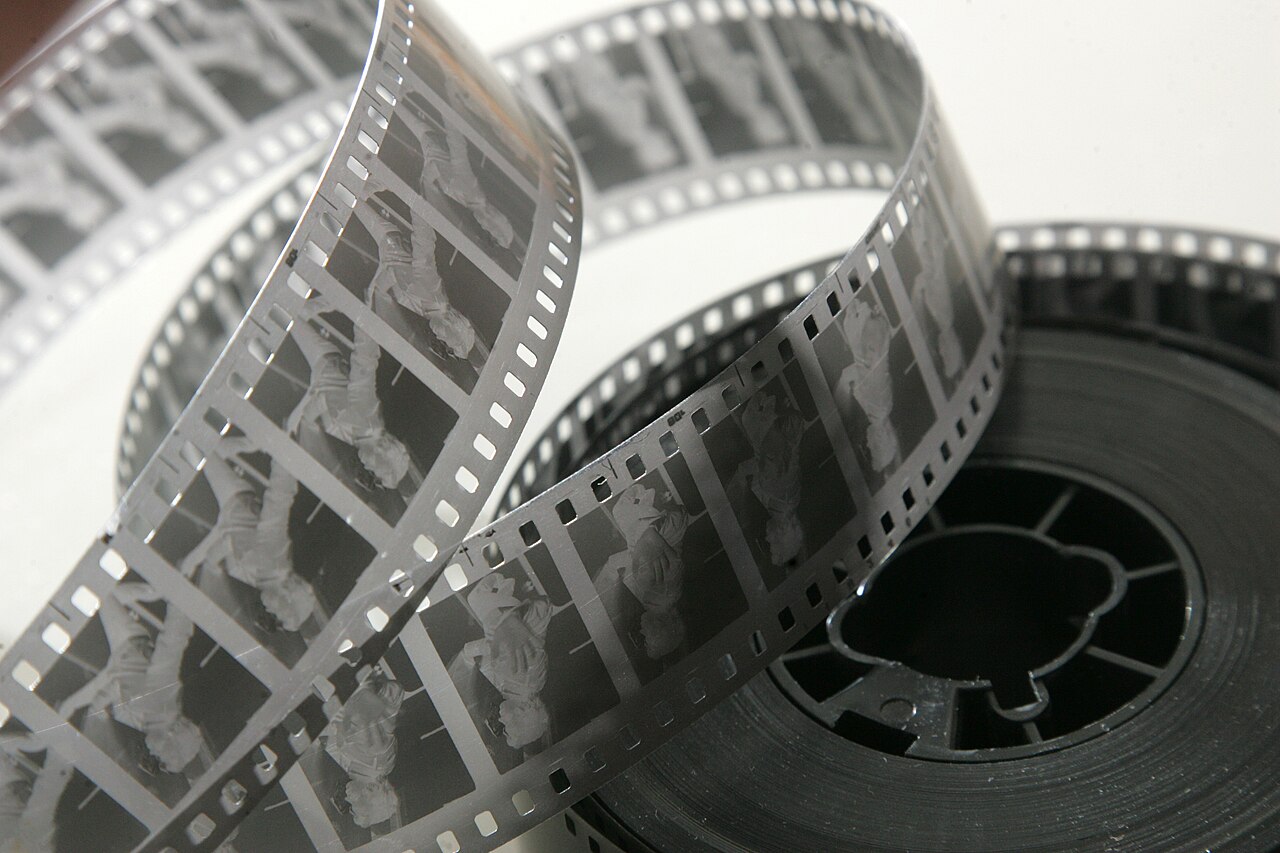
35 mm film: a ribbon of gelatin on plastic, perforated down both edges. The same strip the movie industry has used since the 1890s. [Photo: Runner1616, CC BY-SA 3.0]
How to read this site
The chapters build on each other. Read them in order for a complete mental model of film, from a single silver-halide crystal to a finished scan. If you just want one answer, use the search box (press /) or jump straight to the The film catalogue or the Glossary.
Start with the big questions
A cross-section of a film, layer by layer, and the three-step trick (expose, develop, fix) that every photograph relies on.
Film speed explained properly: ASA, DIN, GOST, the modern ISO number, and why “ISO” on film is a fixed property, not a dial.
Grain, spectral sensitivity, the characteristic curve, and dye chemistry: the four things that make Portra look like Portra.
Kodak versus Eastman Kodak, Harman, the shrinking Fujifilm catalogue, and the maze of rebadged and relabelled stocks.
Every 35 mm film you can reasonably buy in 2026, with a master comparison table and a profile for each.
What happens at the lab: B&W developer families, C-41, E-6, ECN-2, and getting a good digital file off a negative.
A note on sources and accuracy
Evergreen physics and chemistry here is drawn from standard references: Mees & James’s The Theory of the Photographic Process, the Ilford and Kodak technical datasheets, Ansel Adams’s The Negative, and the relevant ISO standards. Fast-moving facts (which films are in production, who makes them) were checked against manufacturer announcements and photography press as of September 2026. Every borrowed image is listed with its licence on the Credits and image licences page.